
My imaging equipment as of 2026
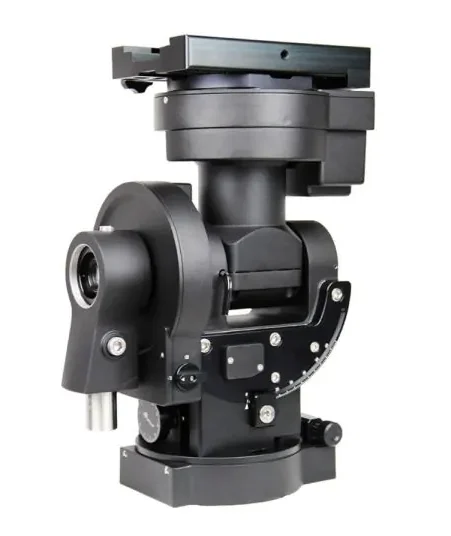
This is my new Ioptron CEM70G mount, for the 2024-25 season. I have wanted one of these for some time and this one came up on the second hand market for an excellent price, it was unused and still in its case. The iOptron CEM70 is a cutting-edge equatorial mount designed to meet the demands of amateur and professional astronomers alike. Known for its advanced features, precision engineering, and versatility, this mount is a superb choice for astrophotography and visual observation. The CEM design is fairly new and offers a much better balance system.
See my YouTube video for a full review of this mount
Features of the iOptron CEM70 mount:
Mount Type: Equatorial Mount
Mounting Capacity: 70 pounds (31.8 kg) Mount
Weight: 27.4 pounds (12.4 kg)
Payload Capacity: The CEM70 can handle substantial telescope setups, making it suitable for various astrophotography and observation configurations.
KeyFeatures: Center-Balanced Equatorial Mount (CEM): The CEM design minimizes the mount's weight and provides better balance, reducing the stress on the mount and tripod. This innovative design enhances stability and tracking accuracy.
GoTo and Tracking Accuracy: With advanced GoTo and tracking capabilities, this mount allows users to easily locate and track celestial objects with great precision.
Built-in GPS: The integrated GPS receiver automatically inputs your location and time data, streamlining the setup process and ensuring accurate GoTo and tracking performance.
Multi-Protocol Mount Control: The CEM70 is compatible with multiple mount control protocols, including ASCOM, iOptron Commander, and more, allowing for flexibility in mount control.
Removable Counterweight Shaft: The mount features a removable counterweight shaft, making it easier to transport and set up the mount in the field.
Mount
As of 2025 I have the Touptek 2600c camera. Its the same sensor as i had in my previous QHY 268C camera, but with an added 2 port USB hub on the back.
I treated myself to this at the start of 2025 it has the Sony back illuminated IMX571 sensor CMOS, super sensitive and nice chip real estate too, it’s a OSC camera, but when used with the Optolong L-Extreme or L-Enhance it produces really nice dual narrowband images.
Paired with my Askar SQA106 this gives me a decent imaging pixel scale of 1.44”/per pixel, It has 6280 x 4210 pixels, 3.76 micron pixel size and a 23.5 x 17.5mm APC-C size sensor. This combination is great and gives a reallt nice FOV, and can be used to image any nebula and also mid to large galaxies, fo smaller galaxy imaging i would move to my Meade 8" SCT, with its 2000mm focal length and tight FOV.
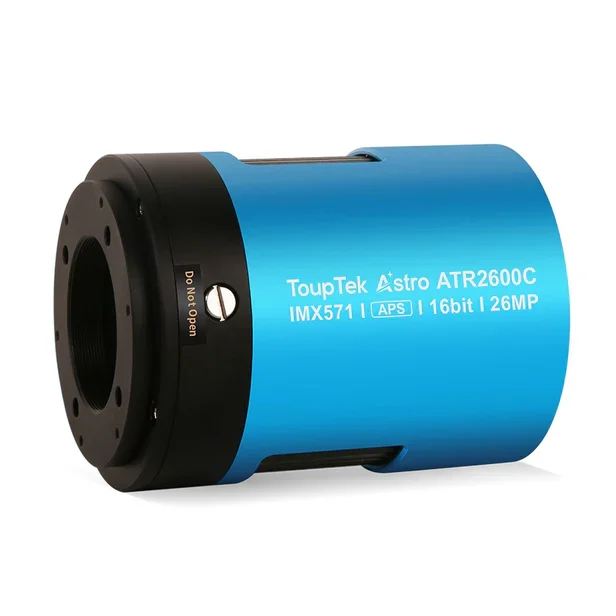
The Touptek IMX571, 2600Cis a colour back illuminated cooled CMOS camera with 16bit ADC. 3.76um pixel size, 26mega pixels. Sony IMX571 sensor. The QHY268C is the CMOS camera with native 16-bit A/D on-chip. The output is real 16-bits with 65536 levels. To compare with the 12bit and 14bit ADC. The 16bit ADC can get high sample resolution, system gain will close to 1e/ADU. No sample error noise and low noise. One benefit of the back-illuminated CMOS structure is improved full well capacity. This is particularly helpful for sensors with small pixels. Even with unbinned 3.76um pixels the IMX571 has a full well capacity of 51ke-
The 2600C has 0.7 electron of read noise at highest gain and 6.8FPS full resolution high readout speed. One electron of read noise means the camera can achieve a SNR>3 at only 4 to 6 photons. This is perfect performance when conditions are photon limited, i.e., short exposures, narrow band imaging, etc., making this large area sensor ideal for sky surveys and time domain astronomy.
The 2600C is a back-illuminated Scientific CMOS camera with extremely low dark current using SONY's Exmor BSI CMOS technology.In general, the fan-blade mechanical shutter will be broken if it is used 200,000 times or so, and in some specific cases it is easy to fail to switch on or off. The advantage of electronic shutter over mechanical shutter is high reliability and stability when the observatory shoots a large number of pictures. The electronic shutter is a relatively perfect choice for the observatory.
Guide Camera
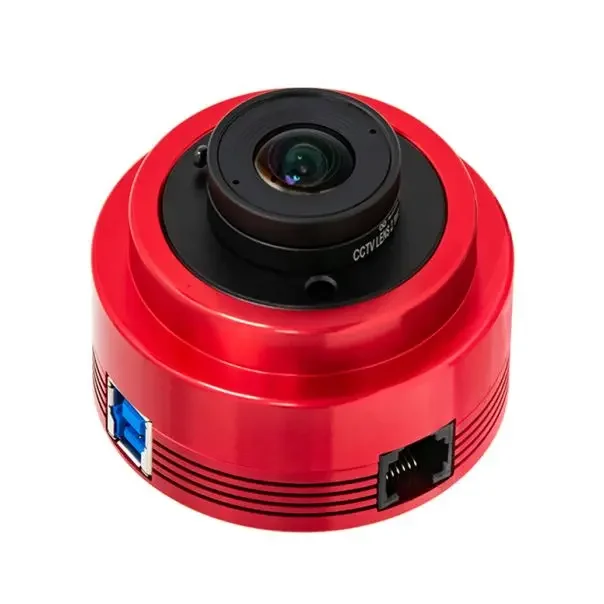
The ASI662MM adopts the Sony IMX662 sensor, has a rolling shutter, a frame size of 1/2.8", a pixel size of 2.9um, and has 2.07 million pixels (1920x1080). In high speed mode the CMOS sensor can output 102.6 frames/second at full resolution and provide a low read noise level. Large full well capacity, not easy to overexpose
The ASI662MM adopts Sony IMX662 sensor with the latest technology. Compared to the previous generation of sensors, it has very low readout noises and an extreme large full well capacity which is 3 times larger than that of IMX 462MM. This helps effectively avoid overexposure issues and also allow longer exposures. In low light conditions, the camera performs excellent, capturing very clear images of celestial objects.
STARVIS 2
ASI662MM adopts the latest SONY IMX662 sensor with the advanced STARVIS 2 technology. Featuring zero amp glow, higher sensitivity to red and near infrared (NIR) light, and 3 times larger full well capacity, it can be regarded as an upgrade of ASI462MM. Also, its dark current noise is several times lower than ASI174MM.
Specifications:
Sensor: 1 / 2.8" CMOS Sony-IMX662AAQR-M
QE peak:91%
Back focus length: 12.5mm
Max fps: 107.6fps
Full well: 37.8Ke
Shutter: Rolling shutter
Resolution: 2.07Mega Pixel,1920x1080
Pixel Size: 2.9µm
Exposure Range: 32μs~2000s
Interface: USB 3.0 /USB 2.0 Type-B
Protect window: φ21-1.1 AR
ADC: 12bit
Imaging Camera
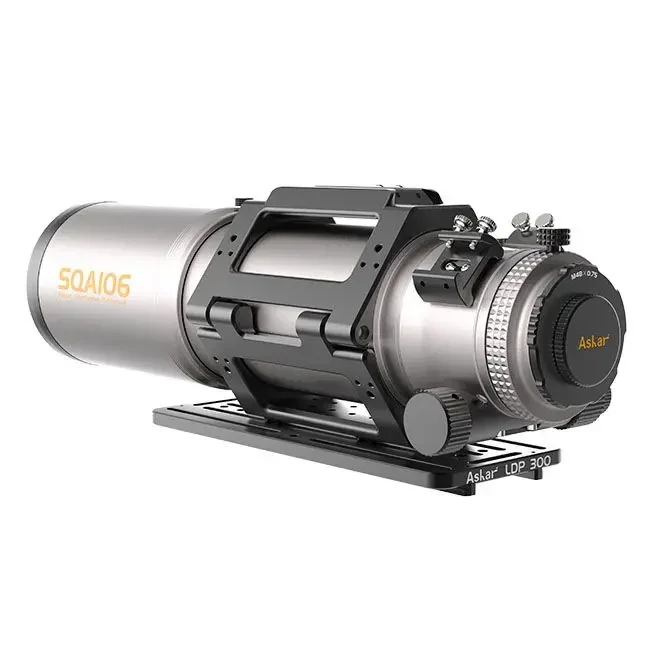
The Askar SQA106, this is my main imaging scope, and i have to say the best scope i have ever owned. The whole build and design is superb, from the rock solid focuser, to the heavy triplet lens at the front and then 2 more lenses closer to the focuser, to give full colour correction and a superb flat field, with no worries of backspace, as long as its in focus the field is flat.
It has a heavy duty fixed ring clamp or clamshell that is fitted with a built in rail clamp on the top for a guide scope or other accessories.
The dew shield is really tight and would stay in place extended even with the tighening screw left loose, unlike my old Esprit 100, which was dire to be honest on this front. The built in rotator is smooth but very firm and offers no sag at all even when loosened. The focuser is very smooth, albeit a little tight, which is inherrant on these scopes apparently, but nothing an Astroasis motor focuser could not handle.
Its a weighty scope at around 5.5kg, but feels really premium in every way.
I dont think i will be swapping this for a long time, if ever, its a real forever scope.
This latest Askar SQA telescope features an air-spaced quintuplet (five lenses) optical system that includes two SD glass elements.
The optical design provides a 55mm corrected image circle, making it an ideal choice for today's high-resolution full-format imaging cameras and Digital Cameras.
With this design, there is no need to use additional screw-on field flatteners.
Focuser: The large 2.8" rigid dual-speed focuser is compatible with most popular motor focusers.
The focus travel is 30mm, and the drawtube is engraved with a high-precision scale. The entire focuser is CNC machined.
Aperture
106mm
Focal Length
509mm
Focal Ration
f/4.8
Objective Lens
Quintuplet petzval APO(including two pieces of SD glass)
Total Length
516mm(when the dew shield is contracted)
586mm(when the dew shield is stretched)
Format Specifications
full frame(44mm),upgrade to the medium format(55mm)
OTA Weight
5.82kg
Gross weight(including tube ring and dovetail plate)
8.12kg
Rear-End Thread Type
Gross weight(including tube ring and dovetail plate)
Rear End Connection Distance
Support 48-78mm range (Recommended connection length is 55mm)
Main Imaging scope
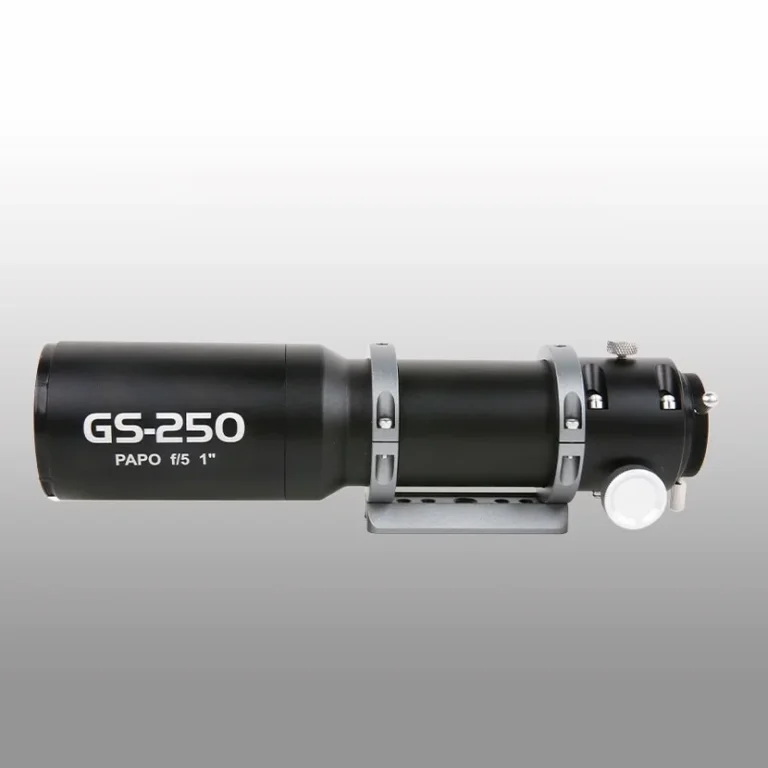
The Touptek GS Series guide scopes feature a proprietary three-element PAPO (planar apochromatic with integrated field flattener) optical configuration, incorporating a single ED element to achieve effective chromatic correction. This is the 250mm f5 version with R&P focuser, there are 3 more sizes in the range.The internal barrel is precision-machined with anti-reflection threads to suppress stray light, while all lenses are coated with multi-layer broadband AR coatings. This greatly enhances image contrast and resolution, ensuring pinpoint star images for accurate, efficient guiding, thus improving the stability of primary telescope imaging.
Designed around a 1-inch flat, well-corrected image circle, the GS Series supports sensors up to the IMX533 size. Versatile in function, it can be used for star-hopping, guiding, visual observing, and even DSO imaging—making it an ideal tool for astrophotography, casual stargazing, and entry-level night-sky photography.
The GS Series guide scopes feature a proprietary 1-inch corrected image circle, three-element PAPO (Planar Apochromatic with integrated field flattener) optical design, incorporating an ED glass element to effectively correct chromatic aberration, astigmatism, and field curvature. This design delivers high resolution and crisp, pinpoint star images. The outstanding optical performance makes the GS Series equally suited for guiding, visual observing, and entry-level astrophotography.